


-
 July 21, 2026
 -
 Comment: 0
The Economics of Branch Banking: Turning Presence into Profitability
For years, conversations around the Indian banking sector have centred on credit growth, digital transformation, financial inclusion, and customer acquisition. These are undoubtedly important metrics. But beneath every successful banking franchise lies a far more fundamental driver of sustainable growth – branch profitability.
In an era where capital is expensive, competition is intensifying, and customer expectations are evolving rapidly, the profitability of individual branches is no longer just an operational KPI. It has become a strategic indicator of whether a bank is allocating resources effectively, building resilient customer relationships, and creating long-term shareholder value.
The Indian banking sector is currently operating from a position of strength. According to the Reserve Bank of India’s Report on Trend and Progress of Banking in India, scheduled commercial banks have reported their strongest profitability in over a decade, driven by improved asset quality, healthy credit growth, and lower provisioning requirements. Gross NPAs have declined to multi-year lows, while Return on Assets (RoA) and Return on Equity (RoE) have steadily improved – clear evidence of a stronger and more resilient banking ecosystem.
Yet these encouraging numbers tell only part of the story.
Enterprise-level profitability often conceals wide disparities across branch networks. Some branches consistently outperform expectations by building strong deposit franchises, maintaining high-quality loan portfolios, and deepening customer relationships. Others struggle with high operating costs, weak CASA mobilisation, or lower business productivity.
This is why sustainable bank profitability is ultimately built one branch at a time.
Every branch represents a unique micro-economy. Customer demographics, competitive intensity, local industries, borrowing patterns, and operating costs differ significantly across geographies. Measuring performance solely through aggregate business volumes fails to capture these nuances. Instead, banks need a granular understanding of how each branch contributes to profitability – not just through revenue generation, but through efficient capital deployment and prudent risk management.
Perhaps nowhere is this more relevant today than in the race for deposits.
While credit demand continues to remain robust, deposit mobilisation has emerged as one of the banking sector’s biggest challenges. Recent industry analysis by CRISIL highlights that credit growth continues to outpace deposit growth, pushing the credit-deposit ratio above 80% and increasing competition for low-cost funding. At the same time, declining CASA ratios have placed additional pressure on banks’ funding costs.
In this environment, profitable branches are those that successfully build sticky customer relationships rather than simply chase lending growth.
A branch with a strong deposit franchise enjoys a structural advantage. Low-cost deposits improve net interest margins, strengthen liquidity, and provide greater flexibility to support future lending. Conversely, branches that rely heavily on expensive term deposits or wholesale funding may report healthy business volumes while contributing relatively little to overall profitability.
Equally important is the quality of the assets being created.
The industry’s recent improvement in profitability has been driven as much by better credit discipline as by business growth. Banks have invested significantly in underwriting standards, portfolio monitoring, and collections, resulting in one of the healthiest balance sheets the sector has witnessed in years. This reinforces an important lesson: profitable growth is not about originating more loans – it is about originating better loans.
The branches that consistently create value are those that balance business expansion with disciplined risk management.
Technology is further reshaping how branch profitability should be viewed.
Historically, branch performance was measured through straightforward metrics such as deposits mobilised, loans disbursed, or accounts opened. While these indicators remain relevant, they are no longer sufficient. Modern banking demands a more holistic understanding of profitability.
Today’s leading institutions increasingly evaluate branches using advanced analytics that combine financial performance with customer lifetime value, digital engagement, cross-sell opportunities, portfolio quality, cost-to-income ratios, and relationship depth. Rather than asking which branches generated the highest business volumes, management teams are asking a more important question: Which branches create the greatest long-term value?
This shift also reflects the changing role of the physical branch itself.
Contrary to predictions that digital banking would make branches obsolete, physical locations continue to play a vital role in relationship-driven banking. Complex lending decisions, MSME financing, wealth management, and advisory services still rely heavily on trusted human interactions. The branch is no longer simply a transaction centre – it is increasingly becoming a relationship and advisory hub where meaningful customer engagement takes place.
This evolution requires a corresponding shift in how success is measured.
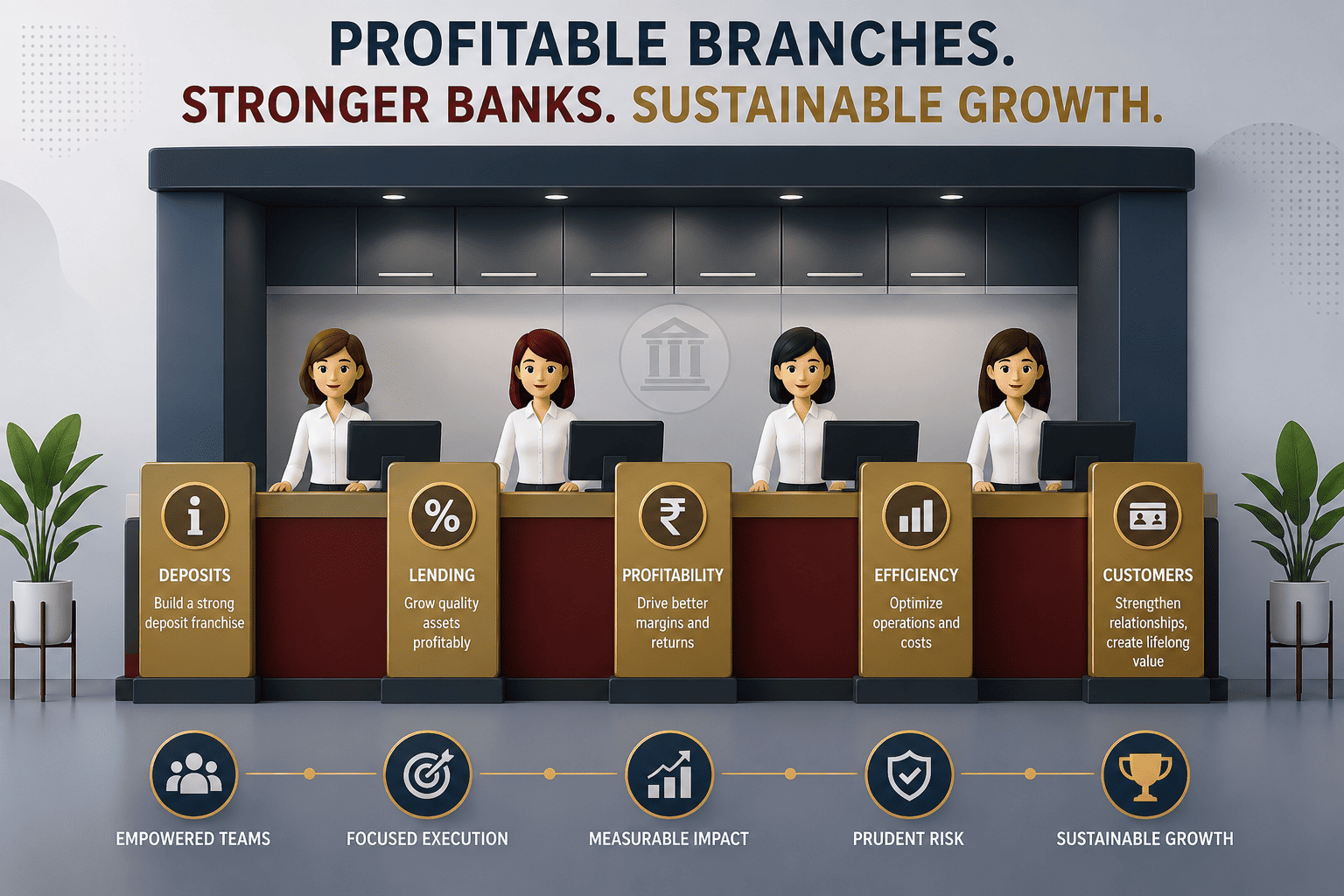
Profitability should no longer be assessed through standalone financial metrics. Instead, banks should adopt a balanced scorecard that evaluates deposit quality, lending performance, operating efficiency, risk-adjusted returns, customer retention, digital adoption, and cross-product penetration. Such a framework provides a more accurate picture of how each branch contributes to enterprise-wide performance.
As banks continue to expand into new markets, branch profitability must also guide investment decisions. Every new branch represents a long-term commitment of capital, talent, technology, and infrastructure. Expansion strategies should therefore be informed by predictive analytics that evaluate local market potential, competitive intensity, customer demand, and expected time to profitability.
The next chapter of Indian banking will not be defined solely by larger balance sheets or faster credit growth. It will be defined by institutions that build stronger, more productive, and more profitable branch networks.
In an increasingly competitive landscape, the most successful banks will be those that recognise a simple truth: sustainable profitability is not created at the corporate headquarters – it is created every day, at every branch, through disciplined execution, stronger customer relationships, and smarter business decisions.
Branch profitability, therefore, is no longer just a financial outcome. It is the clearest reflection of a bank’s operational excellence, strategic discipline, and long-term resilience.