


-
 October 5, 2026
 -
 Comment: 0
Beyond Credit Bureaus: How Alternate Data Could Change the Way Lenders Assess Borrowers in India
For decades, a borrower’s access to formal credit in India has depended largely on a single number: the Credit Score generated from bureau data. This system works reasonably well for those already inside it, individuals with an existing loan or credit card whose repayment history has been tracked and scored. It works considerably less well for the much larger population outside it, the new-to-credit borrower, the gig worker paid in irregular instalments, the small trader whose income never passes through a salary account. For this segment, the absence of a credit history has traditionally meant the absence of credit itself, regardless of how creditworthy they may be.
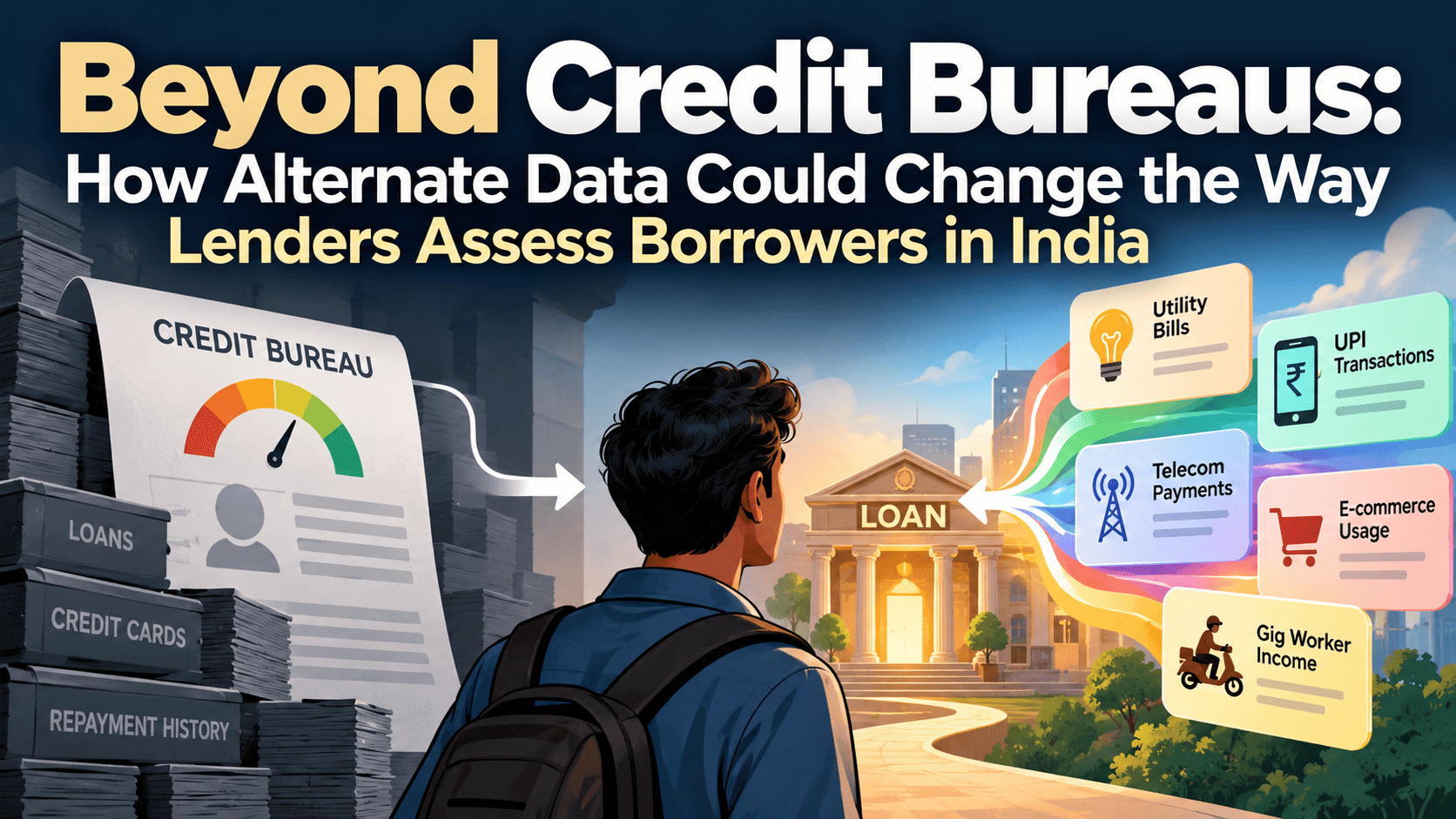
This is the gap that alternate data is intended to close. The term alternate data refers broadly to any information that reflects a person’s financial behaviour and reliability without originating from a traditional loan or credit card account such as utility and telecom bill payments, UPI transaction activity, e-commerce usage, and for gig workers, income records drawn directly from the platforms they earn through. None of these were ever designed as credit signals in the way a repayment history is, but each reflects a pattern of financial discipline that a lender can reasonably read as a proxy for the same underlying quality a Credit Score is meant to capture, the capacity and consistency to repay.
The shift toward using such data is no longer theoretical. Following a push from the government and the Reserve Bank of India for banks to extend loans to new-to-credit customers without established bureau scores, lenders have begun sanctioning first-time borrower loans on the strength of exactly this kind of information. A senior executive at Bank of India has described utility, telecom, UPI, and e-commerce data now being factored into lending decisions for customers with no prior credit footprint, and under the RBI’s Master Direction issued in January 2025, a first-time borrower’s application should not be rejected solely for lack of credit history.
Source: BIIA.com
What this shift reveals, in turn, is how peripheral the Credit Score already was to many lending decisions even before alternate data entered the picture. In home loan assessments, the bureau score reportedly carries a weightage of only around fifteen percent in the overall decision, with vehicle and personal loans following a broadly similar pattern. The Credit Score, in other words, has long been one input among several rather than the determining factor it is often assumed to be. Alternate data simply widens that set of inputs, most meaningfully for the segment of applicants a bureau score was never able to describe in the first place.
Source: BIIA.com
None of this happens outside a regulatory structure, and that structure is tightening rather than loosening. Much of the alternate data now available to lenders flows through the Account Aggregator framework, a consent-based architecture that lets a borrower authorise the sharing of their own financial data between institutions, rather than leaving lenders to source such information independently or without permission. The RBI’s Digital Lending Directions, alongside its more recent FREE-AI framework, place growing supervisory emphasis on underwriting standards, treating responsible assessment as being just as important as the speed digital lending is often prized for. Data localisation adds a further layer of discipline: information generated or processed in connection with digital lending, including credit assessment data, is required to reside on servers within India, with cross-border sharing restricted even for analytical purposes.
Sources: RCM ; IncorpX
This is, in practice, a story of complement rather than replacement. Most Indian lenders now combine traditional bureau-based scores with alternate data in a hybrid model, an approach that reduces false rejections while preserving the risk standards lenders are required to maintain. The Credit Score continues to answer a narrow but useful question, how has this borrower repaid formal credit in the past. Alternate data answers a different one, how does this person manage money in the present, even where no formal credit trail exists to consult.
Source: Airtel
The scale at which this shift is unfolding suggests it is more than a passing experiment. India’s alternative lending sector, valued at close to twenty-seven billion dollars in 2024, is projected to nearly double by 2029, with fintech advancement and regulatory change cited as the principal drivers of that growth. For a country where a meaningful share of the population still sits outside the formal credit system, this expansion carries real consequence, not simply a technical shift in how risk is modelled, but a gradual widening of who gets to be seen by the lending system in the first place, and on what terms.
Source: BusinessWire
What remains to be resolved is not whether alternate data has a role to play, but how consistently and transparently that role is defined. Standardising how different signals are weighed, keeping the models built on this data explainable rather than opaque, and safeguarding consent at every stage of use will determine whether alternate data becomes a durable pillar of Indian lending or merely a temporary patch over a structural gap. The credit bureau is unlikely to disappear from the picture. What is changing is the assumption that it must remain the only one worth consulting.