


-
 August 11, 2026
 -
 Comment: 0
Beyond Eligibility: Why Affordability Will Define the Next Era of Lending in India
The lending industry has mastered eligibility. The next challenge is affordability.
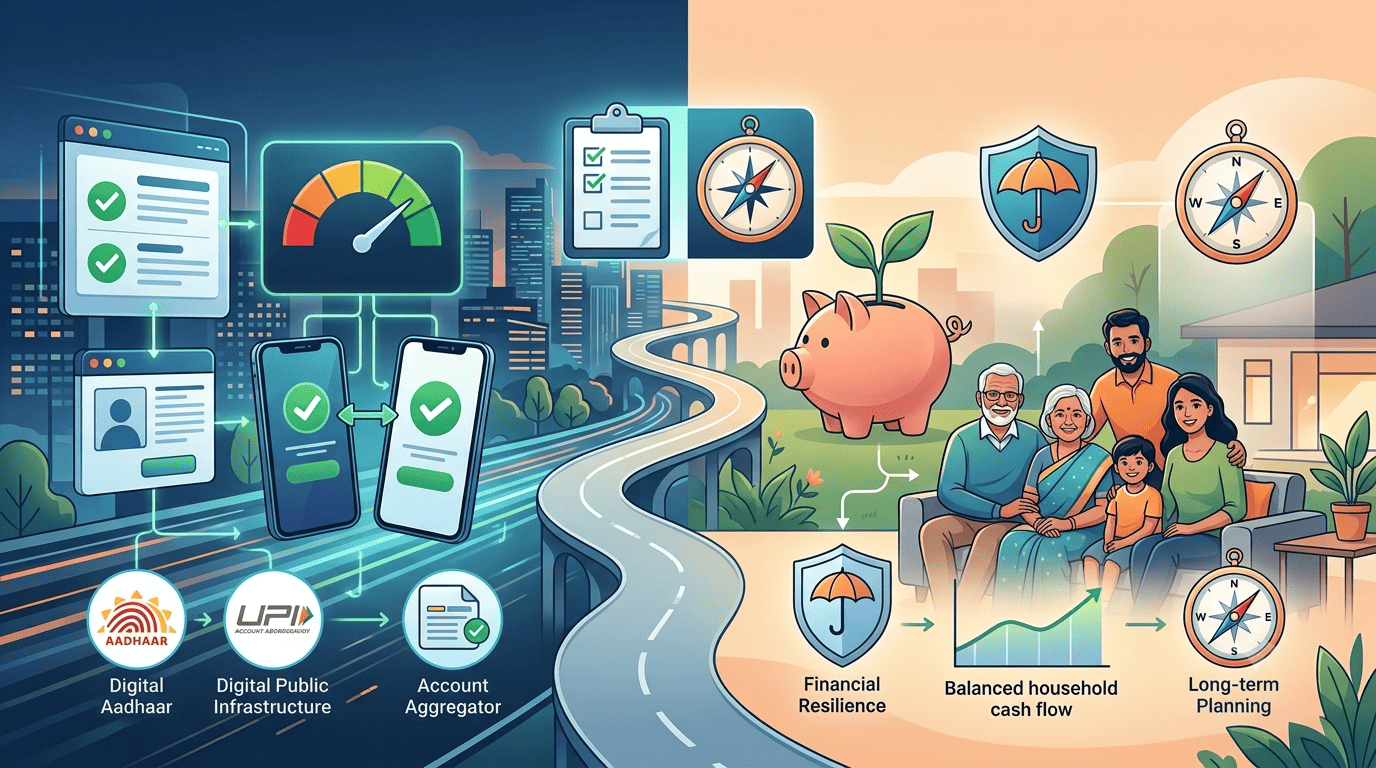
The Indian lending industry has undergone a remarkable transformation over the past decade. What was once a paper-intensive, collateral-driven process has evolved into a technology-enabled ecosystem capable of making credit decisions in minutes. Digital public infrastructure such as Aadhaar, e-KYC, Account Aggregators, UPI and AI-led underwriting has fundamentally changed how lenders assess risk. Bureau scores have become more sophisticated, alternative data has enriched credit models, and automated underwriting engines now enable institutions to evaluate thousands of applications with unprecedented speed and consistency.
In many ways, the industry has solved one of its biggest challenges: determining whether a customer is eligible for credit.
Yet, while underwriting has become significantly better at identifying customers who are unlikely to default, it has become only marginally better at determining whether customers should borrow the amount they qualify for. That distinction is subtle, but it has profound implications for the future of lending.
As competition intensifies and underwriting capabilities become increasingly commoditised, every lender will eventually have access to similar data, similar AI models and similar decision engines. Eligibility, therefore, will no longer be the competitive advantage it once was. The institutions that differentiate themselves over the next decade will be those that move beyond answering, “Can we lend?” to answering a far more difficult question: “How much should we lend?”
That is where affordability enters the conversation.
Affordability is no longer simply an extension of responsible lending. It is emerging as the next frontier of underwriting excellence. Institutions that understand this shift will build healthier portfolios, stronger customer relationships and more resilient businesses. Those that continue to optimise primarily for eligibility may continue to grow, but they also risk creating financially stressed customers who remain technically current on their repayments.
Eligibility Predicts Default. Affordability Predicts Financial Resilience.
One of the industry’s biggest misconceptions is treating affordability as a subset of eligibility. In reality, the two concepts are designed to answer fundamentally different questions.
Eligibility is a probability-of-default model. It looks backwards. It evaluates historical repayment behaviour, current income, employment stability, bureau scores, loan-to-value ratios and existing obligations to estimate whether a borrower is likely to honour future repayments. These are objective, measurable variables that have formed the backbone of retail underwriting for years.
Affordability, on the other hand, is a probability-of-distress model. It looks forward. It attempts to understand how a household will cope with financial commitments over the entire life of the loan, not merely at the point of origination.
This distinction is becoming increasingly important because household finances are no longer static. Rising living costs, changing employment patterns, variable compensation structures, higher healthcare expenses and increasing aspirations have made household cash flows considerably more dynamic than they were a decade ago. A borrower who comfortably qualifies for a loan today may experience very different financial circumstances three years into repayment.
A customer may never miss an EMI and yet gradually weaken their financial position. They may reduce investments, postpone retirement planning, liquidate emergency savings, rely more heavily on unsecured credit or delay essential household expenditure simply to maintain repayment discipline. None of these behaviours appear in delinquency reports. From the lender’s perspective, the loan continues to perform. From the household’s perspective, however, financial resilience is steadily eroding.
This is precisely why eligibility and affordability cannot be viewed interchangeably. One measures the likelihood of repayment. The other measures the sustainability of repayment.
The Cost of Confusing Eligibility with Affordability
The consequences of overlooking affordability extend well beyond individual borrowers.
At the customer level, excessive borrowing often begins with a behavioural bias rather than poor financial judgement. Most lending journeys proudly communicate the maximum loan amount a customer qualifies for. Behavioural economists refer to this as anchoring – the tendency to treat the first number presented as the most appropriate choice. As a result, borrowers frequently perceive the sanctioned amount as a recommendation rather than merely an upper limit determined by risk models.
For lenders, the implications are equally significant. Customers experiencing financial stress may not default immediately, but they often become increasingly dependent on unsecured borrowing, demonstrate lower financial engagement and become more vulnerable during periods of economic uncertainty. Portfolio quality cannot be judged solely by delinquency rates if a growing proportion of borrowers are servicing debt by sacrificing savings and financial security.
At a broader level, affordability also has implications for the financial system itself. India’s credit penetration still remains significantly lower than many developed economies, making responsible credit expansion essential for economic growth. However, sustainable credit growth cannot simply be measured by higher disbursement volumes. It must also be measured by whether households remain financially resilient after taking on debt. An economy where consumers increasingly depend on borrowing to manage routine expenses rather than create productive assets is fundamentally different from one where credit supports wealth creation, home ownership and entrepreneurship.
The objective of lending, therefore, should not merely be to expand access to credit. It should be to expand access to sustainable credit.
Reimagining Underwriting: Four Shifts the Industry Needs
If affordability is to become a meaningful underwriting principle rather than a regulatory aspiration, the industry must fundamentally rethink how credit decisions are designed.
1. Stop Selling the Maximum Eligible Loan
Perhaps the industry’s most overlooked practice is also its most influential. Nearly every lending platform proudly displays the maximum amount a customer is eligible to borrow. While operationally convenient, this creates an unintended behavioural signal that borrowing the maximum amount is also the financially optimal decision.
Instead, lenders should distinguish between eligibility and recommendation.
Imagine a lending journey that presents three clearly differentiated figures: the maximum amount permitted by the risk model, the recommended borrowing amount based on affordability, and a higher borrowing option that explicitly communicates the trade-offs in terms of reduced savings capacity, lower liquidity and increased financial vulnerability.
This simple change would fundamentally alter how customers perceive borrowing. Rather than encouraging them to maximise credit utilisation, it would encourage them to optimise financial outcomes.
2. Replace FOIR with a Financial Resilience Score
For decades, the Fixed Obligation to Income Ratio (FOIR) has served as the industry’s primary proxy for affordability. While it remains a valuable metric, it was developed for a lending environment that was considerably less complex than today’s.
Modern households cannot be understood through income and fixed obligations alone.
Two borrowers earning identical salaries with identical FOIRs may have entirely different affordability profiles depending on whether they have emergency savings, ageing parents, school-going children, variable income, insurance protection or existing unsecured debt.
The next generation of underwriting should therefore move towards a Financial Resilience Score that captures the stability of household finances rather than simply measuring repayment ratios. India’s Account Aggregator ecosystem provides an unprecedented opportunity to make this transition by enabling consent-based analysis of real cash-flow behaviour. Instead of underwriting static income statements, lenders can begin underwriting financial behaviour itself.
3. Make Household Stress Testing a Standard Practice
Corporate lending has long relied on scenario analysis before large credit decisions are made. Retail lending, however, continues to assume that current financial conditions will broadly remain unchanged throughout the tenure of the loan.
That assumption is increasingly unrealistic.
Every significant retail loan should be accompanied by an affordability stress test that evaluates how repayment capacity changes if interest rates rise, household expenses increase, a primary earner experiences temporary income disruption or unexpected healthcare costs emerge.
The purpose of stress testing should not be to reject more borrowers. Rather, it should help lenders structure better loans. In many cases, the outcome may simply be recommending a slightly lower ticket size, a longer tenure or a different repayment schedule that improves long-term affordability without materially affecting access to credit.
The industry’s objective should evolve from sanctioning the largest loan possible to sanctioning the most sustainable loan possible.
4. Underwrite the Household, Not Just the Applicant
Perhaps the most significant shift required over the next decade is recognising that individuals do not repay loans – households do.
Traditional underwriting evaluates applicants largely in isolation, even though repayment capacity is shaped by the broader economic realities of the family. Two borrowers earning identical incomes may have vastly different affordability profiles because one supports ageing parents, funds children’s education or depends on a single household income, while the other benefits from multiple earners and substantially lower financial commitments.
As India’s consent-based data-sharing infrastructure matures, lenders have an opportunity to build underwriting models that evaluate household cash flows, shared liabilities, financial buffers and life-stage obligations. Such an approach would provide a far richer understanding of affordability than conventional income-based assessment and position India among the first major markets to operationalise household-centric underwriting at scale.
The Future of Lending Will Be Defined by Better Decisions, Not Faster Ones.
For years, the industry’s success has been measured through faster approvals, larger disbursements and higher approval rates. Those metrics remain important, but they are increasingly measures of operational efficiency rather than underwriting excellence.
The next competitive advantage in lending will not come from approving loans in thirty seconds instead of three minutes. Nor will it come from marginal improvements in predicting default. Those capabilities will soon become standard across banks, NBFCs and fintechs alike.
The real differentiator will be the ability to determine the right loan amount for the right customer at the right stage of their financial journey.
India’s next phase of credit growth should therefore not be judged by how much more the industry lends, but by how intelligently it lends. Institutions that embed affordability into their underwriting philosophy will build stronger portfolios, deeper customer trust and greater long-term resilience. More importantly, they will help redefine the purpose of lending itself – from merely financing consumption to enabling sustainable financial progress.
The Indian lending industry has spent the last decade mastering the science of eligibility. The decade ahead will belong to institutions that master the science of affordability.