


-
 October 27, 2026
-
 Comment: 0
Rethinking 100% RCU Verification: Balancing Risk Containment with Lending Growth
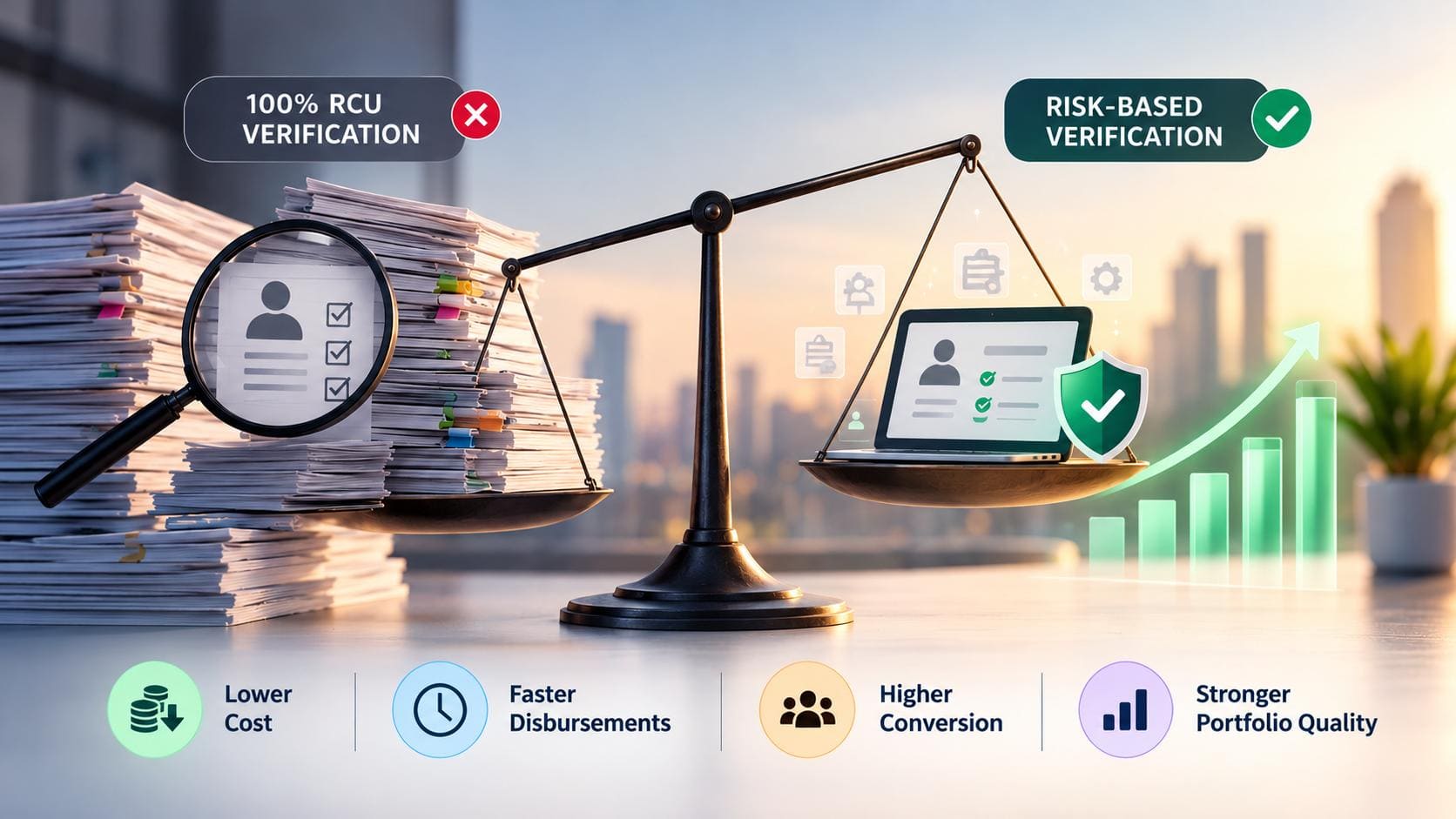
In an increasingly competitive lending landscape, lenders are under pressure to scale disbursements, improve customer experience and maintain portfolio quality, while managing cost of operations. Against this backdrop, 100% Risk Containment Unit (RCU) verification warrants a closer look. While universal verification strengthens the coverage of pre-disbursement controls, applying the same verification intensity across the loan portfolio may not deliver proportionate incremental value.
The question is not whether lenders should strengthen RCU controls, but whether the cost and intensity of verification are aligned with the underlying risk of each loan.
The business cost of blanket verification
A 100% verification model can create trade-offs across three critical lending levers.
First, it increases the cost of origination through verification effort spent on applications with limited incremental risk exposure. Second, it can extend loan turnaround time (TAT), delaying disbursements and potentially impacting login-to-sanction and sanction-to-disbursement conversion. Third, it can constrain RCU capacity, leaving fewer resources available for high-risk applications requiring deeper investigation.
Importantly, higher verification coverage does not automatically translate into lower fraud losses. The effectiveness of RCU depends on its ability to identify material risks and prevent bad disbursements, rather than the proportion of applications reviewed.
Shifting from universal verification to risk-based controls
A more commercially effective approach is to differentiate verification intensity by product, ticket size, sourcing channel, customer profile, geographic exposure and historical fraud experience.
Low-risk applications with consistent documentation and strong validation signals can follow streamlined verification pathways, subject to mandatory policy and regulatory checks. Medium-risk applications can undergo targeted verification, while high-risk applications trigger enhanced document scrutiny, field investigations or specialist review.
This approach enables lenders to deploy RCU capacity where the potential loss avoided is highest, rather than distributing resources uniformly across the portfolio.
Quantifying the impact on lending economics
The business case should be assessed across a balanced set of metrics: verification cost per application, login-to-disbursement TAT, application conversion, fraud losses as a percentage of disbursements, early delinquency and RCU productivity.
For instance, a lender processing 10,000 applications monthly could evaluate whether risk-based verification reduces manual verification effort and processing delays without increasing fraud incidence or early-bucket delinquency. The assessment should compare outcomes against the existing operating model, using a controlled pilot and clearly defined risk thresholds.