


-
 September 22, 2026
 -
 Comment: 0
You Outsourced the Process. You Didn’t Outsource the Risk
Why third-party dependencies are becoming a strategic consideration for HFCs and NBFCs
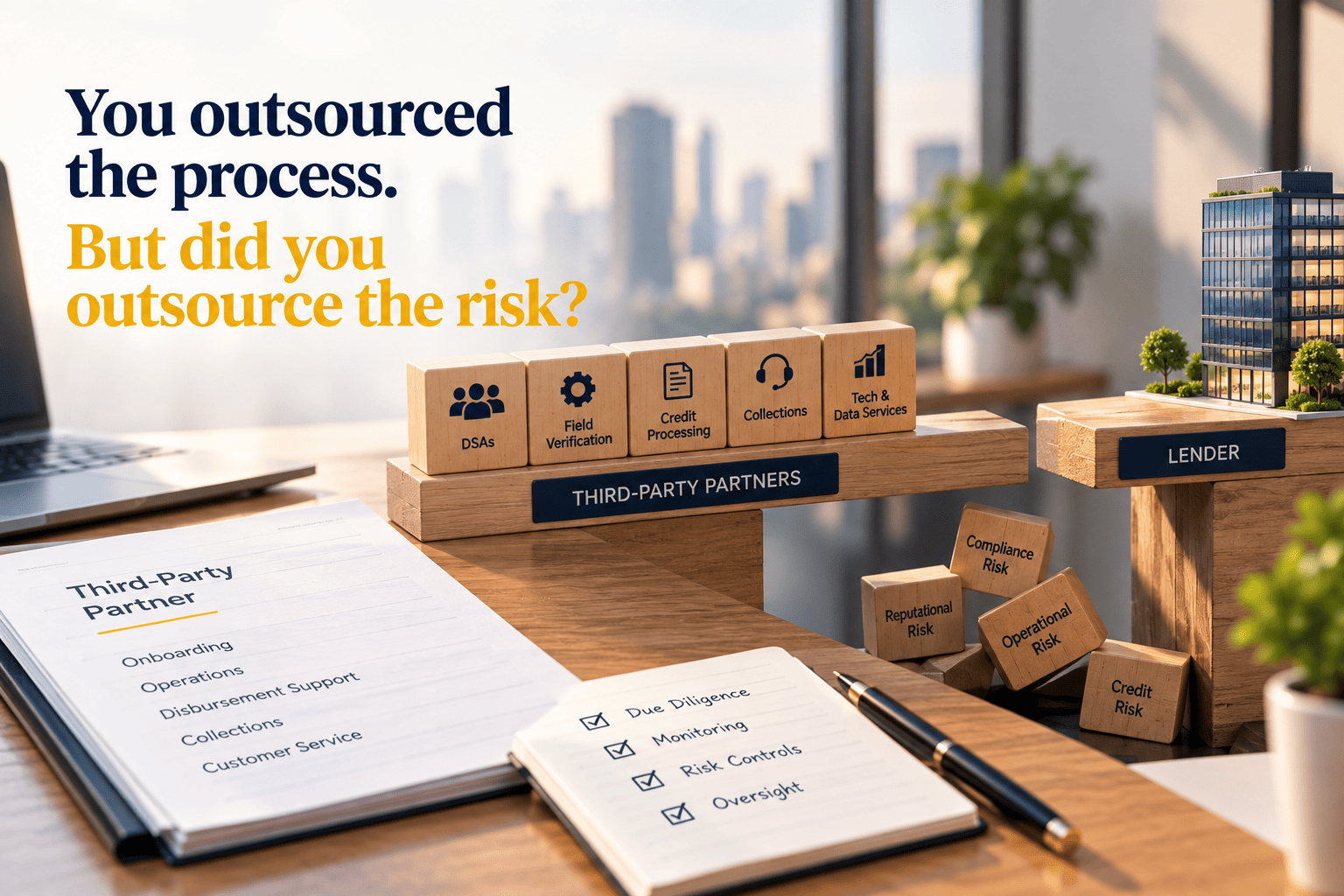
As HFCs and NBFCs scale, outsourcing has become an important enabler of growth. From field verification and property assessment to technology, collections, document processing and customer acquisition, third-party partners can provide specialised capabilities, geographic reach and operating flexibility that may be difficult to build entirely in-house. The question, therefore, is not whether lenders should work with vendors. The more strategic question is: As dependence on third parties increases, is the organisation’s risk governance evolving at the same pace?
- The outsourcing equation has changed
Historically, vendor management was often viewed primarily through a procurement lens: select the right partner, negotiate the right SLA, monitor performance and renew the contract. But some third-party activities now sit directly within critical parts of the lending value chain.
A field investigation partner can influence the quality of information reaching credit. A technical or legal service provider can contribute to collateral assessment. A collection agency can influence customer experience and conduct risk. A technology partner can become critical to the continuity of a lending process. This does not mean that these activities should not be outsourced. It means that the risk associated with an outsourced activity needs to remain visible to the lender even when execution sits outside the organisation.
The RBI’s outsourcing framework reflects this principle: outsourcing does not diminish the regulated entity’s obligations, and the Board and senior management retain ultimate responsibility for outsourced activities. The framework also identifies risks including operational, compliance, legal, reputation, counterparty, concentration and exit-strategy risks.
- From vendor performance to vendor criticality
One of the most important shifts for lenders is to stop treating every vendor relationship in the same way. Not every vendor carries the same level of risk. The appropriate level of oversight should depend on the vendor’s criticality, business dependency, potential customer or portfolio impact, control environment and ease of replacement. Greater attention is warranted where a third party supports a critical lending process, has limited alternatives, handles sensitive customer activities or where disruption could materially affect business continuity.
- The SLA may not tell the whole story
A vendor can meet its contractual SLA and the underlying risk can still remain.
For example, a field verification agency may meet turnaround-time requirements consistently. But the more important question may be whether the verification is identifying the right risk signals. Similarly, a technology provider may achieve system-availability targets while a process continues to generate manual workarounds or control gaps. This suggests a broader approach to vendor monitoring.
- The missing piece: resilience
Vendor governance often receives significant attention during onboarding. Due diligence is performed. Contracts are signed. SLAs are established. Reviews are scheduled. But the more difficult question is: What happens if the relationship suddenly stops working?
RBI’s outsourcing framework specifically highlights the importance of contingency planning, contractual protections, access to relevant records, audit rights and appropriate termination or exit arrangements. For lenders, this means vendor resilience should be considered before disruption occurs not after.
- The strategic shift
The answer is not to bring every outsourced activity back in-house. In many cases, doing so could reduce flexibility, increase costs or limit access to specialised capabilities. The objective is different: retain sufficient ownership, visibility and control over the risks created by the outsourcing arrangement. For HFCs and NBFCs, this becomes increasingly important as lending ecosystems become more interconnected and operating models rely on a wider network of specialised partners. The strongest vendor governance model is therefore not necessarily the one with the most controls.
It is the one that knows where third-party dependency can materially affect the business and concentrates governance where it matters most.
Because ultimately:
You can outsource the activity.
You can outsource the execution.
But you cannot outsource accountability for the risk.